
A special holiday is coming up, nothing more than the special day of the 4th of July, and here is your forecast breakdown in depth for each region.
Overall, when looking at guidance and agreement with models, as well as the fundamental pattern, clearly we can see an amplified mid-summer pattern across the US on Independence Day. The 500 mb height cyclonic relative vorticity field valid at roughly 23-24Z (3-4pm PT) on Saturday, July 4th, is showing a record-challenging ridge dominating the eastern and southern tiers of the country, with a 500 mb height peaking between 592 and 594 dm. At the same time, we see short-wave energy digging a trough advancing in the Great Lakes region, while the Northwest and Southwest enjoy a pleasant 4th of July. This should be a very interesting pattern to break into for some. Let's go in depth.
While some areas will see a very nice, pleasant day and night when it comes to seeing fireworks and having a blast for the 4th of July, others will deal with severe thunderstorms, really unbearable heat, and swampy humidity. Very impactful weather that may or may not delay or cancel events that were planned for this special day. Let's break it down region by region.
Far Northwest Forecast Discussion:
While a cool and cloudy troughing pattern is keeping conditions unsettled and bringing light showers through Thursday, the pattern decisively shifts heading into the weekend. As ridging builds into the central and western U.S., 500 mb heights will increase and the flow will transition to a drier westerly regime. Therefore giving away for a pleasant weekend overall. The primary impact is highly favorable weather for outdoor celebrations aka no impact. Have a wonderful celebration.
Southwest and West Coast Forecast Discussion:
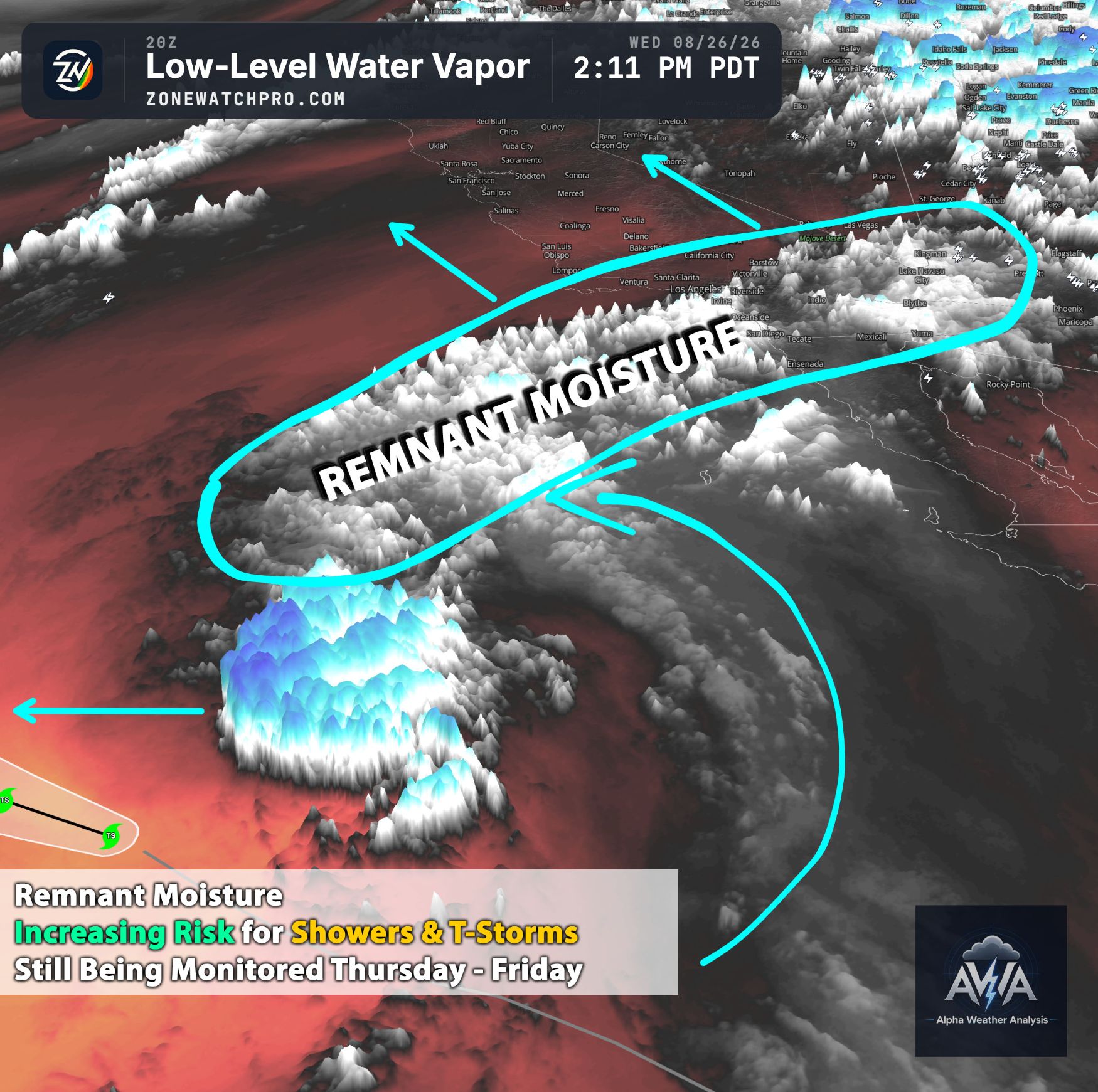
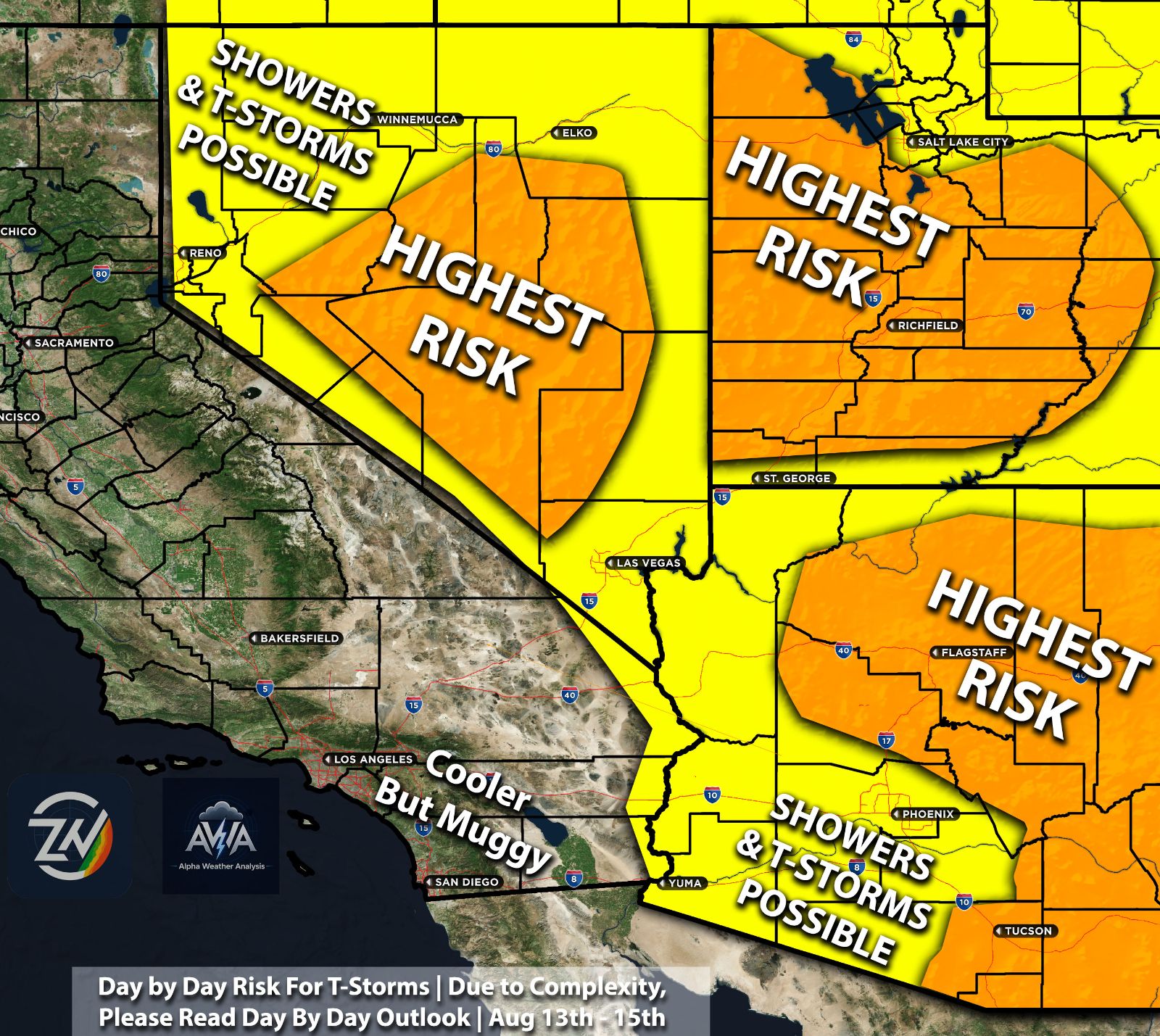
Southwest remains under the influence of intense, dry heat, with high temperatures easily pushing well into the triple digits for some (AZ we’re looking at you). The combination of extreme heat, exceptionally low relative humidity, and dry antecedent conditions maintains extremely critical fire weather, particularly across the Four Corners region, Utah, Colorado, and Arizona. Other areas depending on where you are see pleasant weather especially near the coast where temperatures will be mild with perfect conditions for a fun 4th of July. We’re talking mild temperatures for most for majority of CA coast from north to south (besides cloud cover especially near the coast on and off for some the most day). Southern CA could get some mid level to upper level moisture from remnants of what used to be a tropical storm so possible a shower or two...Going a bit inland you’ll see temperatures rise but not anywhere near temperatures across the 4 corners (for exact temperatures check ZoneWatch). Really not too much impact. Mother Nature will not give you fireworks here for now.
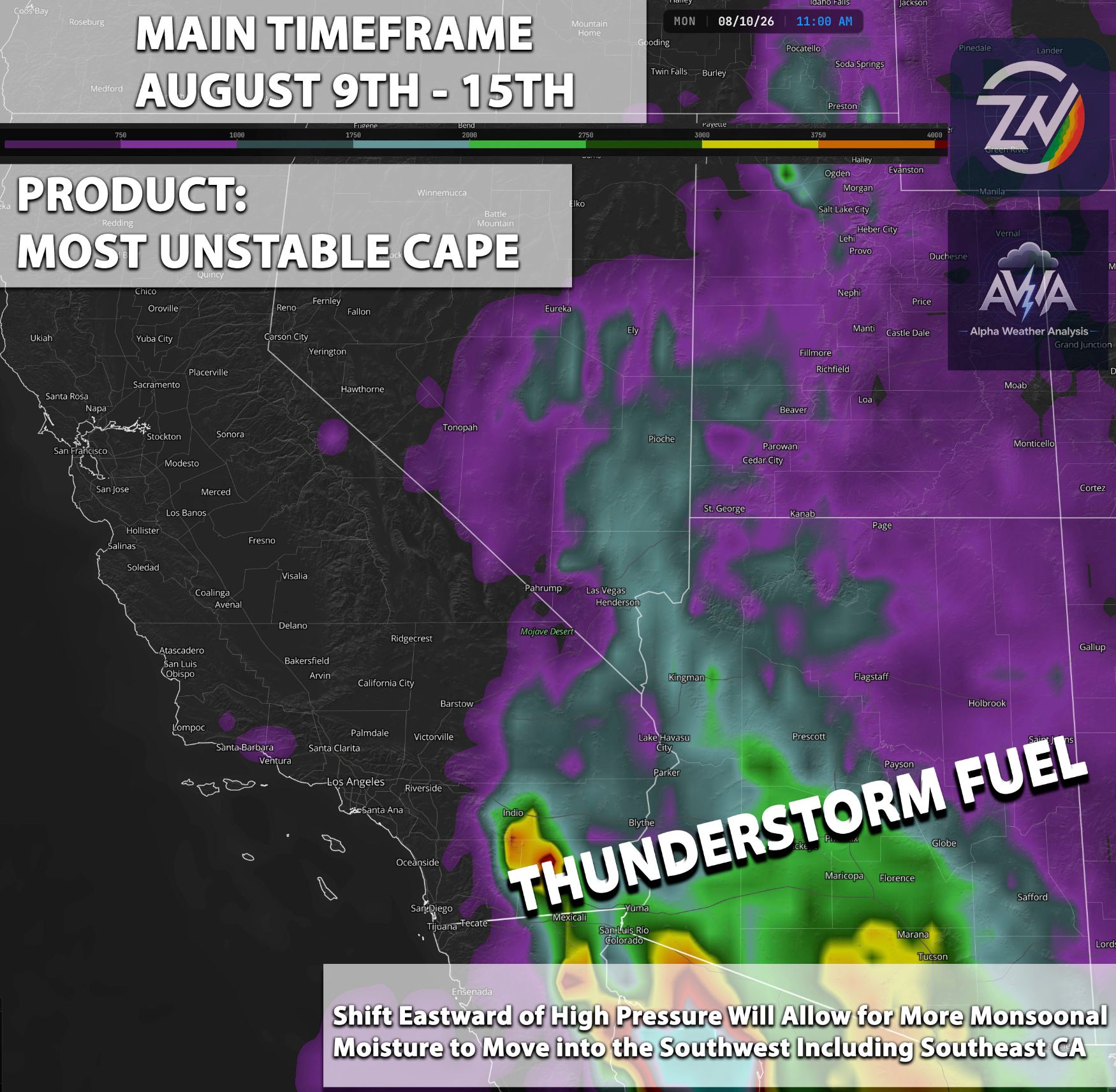
Below we can see plenty of instability across the area which will be one of the major ingredients to watch for areas that have a risk for severe storms while other areas will be caped as stated int the breakdown. Image directly from ZoneWatch web dashboard.
Central Plains Forecast Discussion:
Not the same can be said for your region, Central & Upper Plains. You are under the active, impactful weather, unfortunately, and Mother Nature will definitely give you fireworks. As shortwave energy ejects from the Rockies and interacts with the warm, moist sector ahead of an advancing boundary, convective initiation is expected. There is a pronounced risk for severe thunderstorms and localized flash flooding across the Plains. Forecast soundings indicate ample instability, meaning any convection that develops could quickly go severe. Effective shear in the mid 40s range across the Front Range will make any of these storms go severe quit quickly. This poses a significant threat to outdoor events, with hazards including large hail, damaging wind gusts, and intense lightning. Should conditions change, an update will come out. High likelihood for impact for any plans for your 4th of July.
Southern Plains Forecast Discussion:
Another location with a complicated pattern with most likely some impact in a hit or miss fashion setup. Think of the normal summer popcorn isolated t-storm risk. oppressive heat, with widespread high temperatures in the upper 90s to low triple digits and peak heat indices reaching 100°F to 105°F. However, a weak shortwave trough propagating across the region will provide enough synoptic lift to break the cap (CINH), introducing a pulse-type thunderstorms during the late afternoon and evening hours (pop corn storms). In Oklahoma, this activity will initially favor the southeast, while a separate cold front dropping out of Kansas could initiate overnight convection across northern counties. In North and Central Texas, this isolated storm development will be primarily confined to areas north of I-20 and east of I-35. While organized severe weather (such as large hail or tornadoes) is not expected, these isolated storms present a highly specific hazard for evening times. Forecast soundings highlight deep, dry sub-cloud layers with 20 to 25-degree temperature dewpoint spreads at the surface. This inverted-V thermodynamic profile is exceptionally favorable for efficient cold pool generation (downward winds threat). As a result, any collapsing thunderstorm will be capable of producing strong, sudden downbursts and gusty outflow winds. So, very hot & muggy conditions with popcorn t-storms will be something to watch when making plans. Have a way of receiving alerts when lightning strikes your area such as ZoneWatch second by second lightning detection.
Midwest Forecast Discussion:
With the current pattern continuing with very unpleasant hot and muggy conditions, as well as ingredients for mainly damaging wind storms and more severe weather across some portions of the Midwest, there will be a definite impact expected to your plans outside. Let's break down the pattern. A highly volatile setup is taking shape. Agreement with the pattern continues to show a trough and a cold front digging into the Great Lakes by Saturday afternoon. Ahead of this front, extreme heat and humidity will pool, followed by an increasing risk for severe thunderstorms. MLCAPE (mixed layer CAPE or instability) around 3000 J/kg and DCAPE (downward CAPE) exceeding 1000 J/kg, coupled with increasing 700-500 hPa layer winds nearing 30 knots. This kinematic and thermodynamic parameter space supports organized severe convection as the ridge weakens and large-scale ascent increases. The primary threat will be severe downbursts and damaging straight-line winds, capable of severely impacting holiday gatherings and causing major impacts for the 4th.
East Coast Forecast Discussion:
Another complicated setup with record-breaking temperatures continuing and very humid conditions as well, giving away for your 4th of July. A few storms maybe severe with the main risk being damaging straighline winds. Heat index will soar between 105°F and 115°F, creating unpleasant conditions for those without adequate cooling and hydration. While a strong capping inversion (aka cap holding storms from forming at first) may suppress widespread convection early in the day, the approaching trough from the Great Lakes will slowly erode the ridge, introducing a risk for isolated to scattered severe thunderstorms by the late afternoon and evening. Any storm that manages to break the cap could produce strong to severe localized downbursts given the extreme instability as well as DCAPE… Unfortunately, heads up for pop up storms that maybe strong to severe during the firework show which will be monitored… Hopefully, Mother Nature doesn’t clash its own type of light show with the spectacular fireworks across NYC and the east coast.
Storms exploded across the NYC area around 5pm ET...
Southeast Forecast Discussion:
More muggy and hot conditions expected across the Southeast region… Widespread heat index’s exceeding 105°F are expected. The region largely lacks strong synoptic forcing, so the primary triggers for precipitation will be localized outflow boundaries and the sea breeze. Any thunderstorms will be highly isolated but could feature intense tropical downpours and frequent lightning due to the deeply moist and unstable airmass. Severe storms are not expected but, strong downward winds can be a risk given the setup…
Stay tuned for more updates and have a wonderful 4th of July wether from Mother Nature or the spectacular fireworks celebrating 250 YEARS.